




Grace Oh has played her violin all over the world, in cathedrals and amphitheaters and concert halls. But she also plays a mean clarinet—slightly unusual for a musician of her caliber. “My colleagues always laugh when they find out about that—they think it’s wild!” Grace chuckled. But that, in and of itself, is a beautiful by-product of Adventist education.
Grace began taking piano lessons at age 3 and violin at 5, following in the footsteps of her older brother and cousins. So when she started kindergarten at Glendale Adventist Academy (GAA) in Southern California, the music classes that were a part of the daily curriculum were a cinch for her. “We started with general music education—reading notes, learning to sight sing, clapping rhythms,” Grace recalled. And while she took it for granted at the time, she realizes now what a gift it was to be a part of a system and community that valued and prioritized music. “The music education I received at GAA was truly invaluable during those formative years of my life. It absolutely set the course for how I approach music.”
As her technical and artistic skills developed, Grace could have transferred to a charter school or music conservatory—places that would have both allowed and expected her to focus fiercely on the violin, dedicating hours of practice a day to the art. This educational background is commonplace for many professional musicians.
But not only did Grace finish her high school years at GAA, she also chose to attend La Sierra University rather than any nationally renowned state university or school of music. “I began studying with Lynden Johnston Taylor in high school and knew that I wanted to continue working with him during my time as an undergraduate.” She was inspired to be in the company of a fellow Seventh-day Adventist who was doing exactly what she aspired to be—a professional orchestral musician. Dr. Taylor came from a similar background and understood both the pressure and allure of pursuing a career in the medical professions. “If it wasn’t for the mentorship I received from Dr. Taylor, I might not have stayed the course or felt my goals were attainable.”
Besides the expert tutelage of her professor, Grace thrived in the small school environment that she found at La Sierra University. She received strong support from the music department faculty, as well as from professors in other departments and the administration. She also had a myriad of opportunities to play—in concerts, recitals, and alongside faculty in chamber ensembles. Each performance helped to hone her talent and enhance her self-confidence. After four years at La Sierra University, she won a full scholarship to the University of Michigan. “I knew that I had a lot of work to do still, but I also didn’t feel completely overwhelmed or out of my league. I could hold my own.”
Grace’s calendar is packed these days. As a freelance musician in Los Angeles, her gigs take her all over the place—from recording studios to the Hollywood Bowl—and she enjoys immensely the variety of performances, venues, and expectations. “I recently played in a symphonic concert that featured music by [Gustav] Mahler. That style of playing is very different from the jazz show I did two nights ago—different rhythms, different sounds.” Recording work stands in sharp contrast to those as well. “For that, you rely heavily on your ability to sightread. There’s no time to prepare—you just have to walk in and do it.”
One look at her list of recent studio work (which includes Moana 2, Inside Out 2, Transformers, and Oppenheimer) and live performances (multiple instances under the baton of John Williams and Gustavo Dudamel), and it’s clear that Grace has found her way in the cutthroat world of professional musicians. “How did I do it? I don’t know.” Grace shook her head, brushing aside the accolades I began rattling off. But that’s actually it—Grace’s goal has always been to support everyone around her, to make music not at the expense of others but in tandem with others.
Her academy music teacher, Dr. Brenda Mohr, noted, “I recognized early on that Grace possessed a very special, God-given gift. Yet her musical excellence is only part of her story. Through her years in choir and band ensembles, Grace consistently demonstrated the character cultivated through Christian education—humility, graciousness, servant leadership, and a genuine care for others. She was always willing to support her fellow students and approached every opportunity, on and off the stage, with integrity and teamwork.” Adventist education instilled in her a work ethic and worldview that pushed her to do her best while being a part of a team and a process.
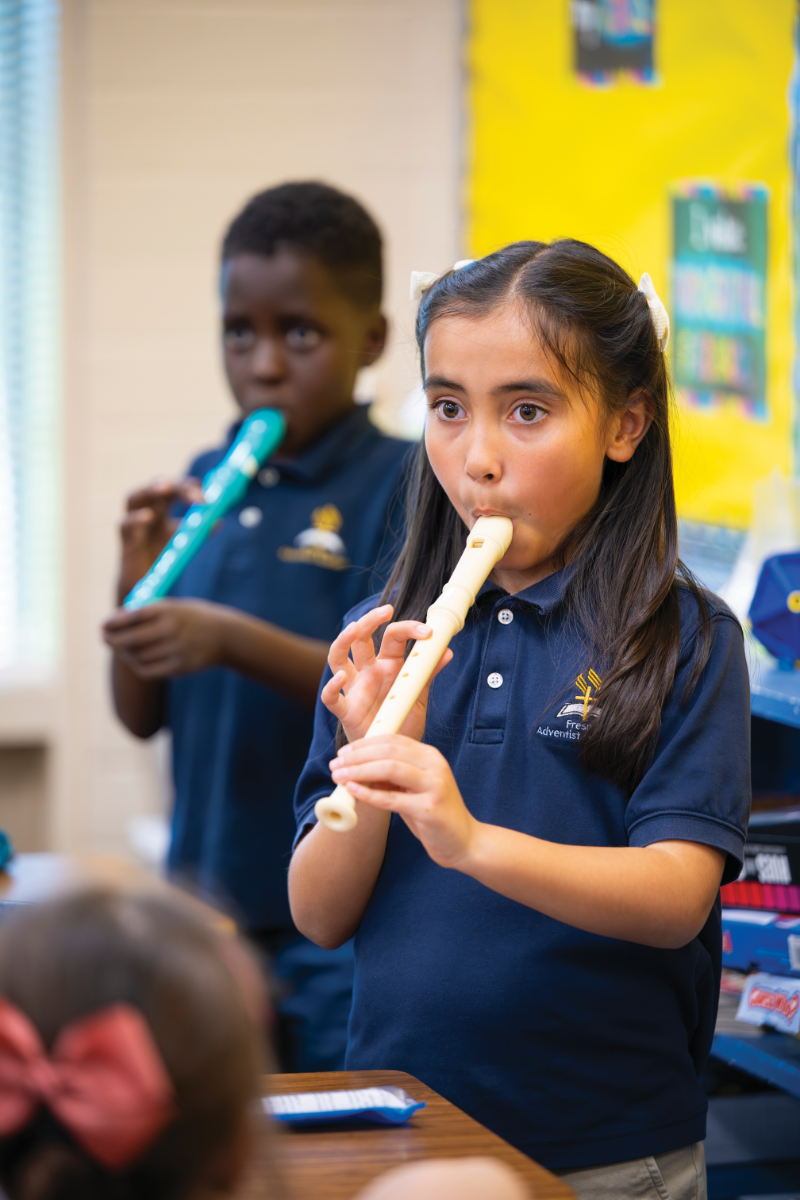
So what about that clarinet? Because GAA didn’t have a string ensemble, 10-year-old Grace chose to join band and learn the clarinet. She continued playing all the way through college, an experience that has only served to make her into a better, more well-rounded musician. Need more evidence? You can find Grace next playing for the Los Angeles Opera this spring.
_____________________________
Aimee Leukert is vice president for student and spiritual life at Pacific Union College.
Donde la fe y la música se encuentran: Grace Oh
Por Aimee Leukert
Grace Oh ha tocado el violín por todo el mundo, en catedrales, anfiteatros y salas de conciertos. Pero también toca el clarinete de manera excelente, algo inusual para una música de su calibre. «Mis compañeros siempre se ríen cuando se enteran de eso, ¡les parece una locura!» Grace se rió. Pero eso, en sí mismo, es un hermoso subproducto de la educación adventista.
Grace empezó a tomar clases de piano a los 3 años y de violín a los 5, siguiendo los pasos de su hermano mayor y sus primos. Así que cuando empezó el jardín de infancia en Glendale Adventist Academy (GAA) en el sur de California, las clases de música que formaban parte del currículo diario eran para ella. «Empezamos con la educación musical general: leer notas, aprender a cantar a primera vista, palmar ritmos», recordó Grace. Aunque en ese momento lo daba por sentado, ahora se da cuenta de lo valioso que fue formar parte de un sistema y una comunidad que valoraba y priorizaba la música. «La educación musical que recibí en GAA fue realmente invaluable durante esos años formativos de mi vida. Sin duda marcó el rumbo de mi enfoque musical».
A medida que desarrollaba sus habilidades técnicas y artísticas, Grace podría haberse trasladado a una escuela concertada o a un conservatorio de música —lugares que le habrían permitido y esperado que se centrara intensamente en el violín, dedicando horas diarias de práctica al arte—. Esa formación educativa es común para muchos músicos profesionales.
Pero no solo terminó sus años de high school en GAA, sino que también eligió asistir a La Sierra University en lugar de a cualquier universidad estatal o escuela de música de renombre nacional. «Empecé a estudiar con Lynden Johnston Taylor en high school y sabía que quería seguir trabajando con él durante mi etapa de universidad». Se inspiró para estar en compañía de otro adventista del séptimo día que hacía exactamente lo que ella aspiraba ser: una música orquestal profesional. El Dr. Taylor provenía de un entorno similar y comprendía tanto la presión como el atractivo de seguir una carrera en las profesiones médicas. «Si no fuera por la mentoría que recibí del Dr. Taylor, quizá no habría seguido adelante o no habría sentido que mis objetivos eran alcanzables».
Además de la experta enseñanza de su profesor, Grace prosperó en el pequeño entorno escolar que encontró en La Sierra University. Recibió un fuerte apoyo del profesorado del departamento de música, así como de profesores de otros departamentos y de la administración. También tuvo una infinidad de oportunidades para tocar: en conciertos, recitales y junto a profesores en conjuntos de cámara. Cada actuación la ayudó a perfeccionar su talento y a aumentar su autoestima. Tras cuatro años en La Sierra University, ganó una beca completa para University of Michigan. «Sabía que aún tenía mucho trabajo por hacer, pero tampoco me sentía completamente abrumada ni fuera de mi capacidad. Podría defenderme sola».
La agenda de Grace está llena estos días. Como música freelance en Los Angeles, sus conciertos la llevan a todas partes —desde estudios de grabación hasta el Hollywood Bowl— y disfruta enormemente de la variedad de actuaciones, locales y expectativas. «Recientemente toqué en un concierto sinfónico que contó con música de [Gustav] Mahler. Ese estilo de tocar es muy diferente al del espectáculo de jazz que hice hacía dos noches: ritmos distintos, sonidos diferentes». El trabajo de grabación contrasta fuertemente con esas obras también. «Para eso, dependes mucho de tu habilidad para leer a primera vista. No hay tiempo para prepararse —solo tienes que entrar y hacerlo».
Basta con echar un vistazo a su lista de obras recientes en estudio (que incluye Moana 2, Inside Out 2, Transformers, y Oppenheimer) y actuaciones en directo (en múltiples ocasiones bajo la batuta de John Williams y Gustavo Dudamel), y está claro que Grace ha encontrado su camino en el despiadado mundo de los músicos profesionales. «¿Cómo lo hice? No lo sé». Grace negó con la cabeza, desechando los elogios que yo había empezado a enumerar. Pero eso es todo: el objetivo de Grace siempre ha sido apoyar a todos los que la rodean, hacer música no a costa de los demás, sino en conjunto con otros.
Su profesora de música en la academia, la Dra. Brenda Mohr, señaló: «Reconocí desde el principio que Grace poseía un don muy especial, dado por Dios. Sin embargo, su excelencia musical es solo una parte de su historia. A lo largo de sus años en coros y conjuntos de banda, Grace demostró de forma constante el carácter cultivado a través de la educación cristiana: humildad, cortesía, liderazgo de servicio y un genuino interés por los demás. Siempre estuvo dispuesta a apoyar a sus compañeros y afrontó cada oportunidad, dentro y fuera del escenario, con integridad y trabajo en equipo». La educación adventista le inculcó una ética de trabajo y una visión del mundo que la impulsaron a dar lo mejor de sí misma formando parte de un equipo y de un proceso.
¿Cómo fue que aprendió a tocar el clarinete? Como GAA no tenía un conjunto de cuerdas, Grace, a los 10 años, decidió unirse a la banda y aprender a tocar el clarinete. Siguió tocando durante todo su tiempo en la universidad, una experiencia que solo la ha convertido en una música mejor y más completa. ¿Necesitas más pruebas? Puedes encontrar a Grace tocando esta primavera para Los Angeles Opera.
_____________________________
Aimee Leukert es vicepresidenta de vida estudiantil y espiritual en Pacific Union College.