
Adventist Pioneers in the West
By the Recorder editorial staff
“On our way home from Mountain View, we passed through San Francisco, and, hiring a carriage, spent an hour and a half in viewing the destruction wrought in that great city.” Ellen White
One of the most significant events of Adventism’s early days in the West was the San Francisco earthquake of 1906. Ellen White happened to be in California, attending the consecration service for Loma Linda College of Medical Evangelists and the dedication of Paradise Valley Sanatorium. She had two visions at that time, with representations of a terrible earthquake, though she was careful not to say that these visions specifically related to what was to happen shortly in San Francisco. She wrote:
“While at Loma Linda, Cal., April 16, 1906, there passed before me a most wonderful representation. During a vision of the night, I stood on an eminence, from which I could see houses shaken like a reed in the wind. Buildings, great and small, were falling to the ground. Pleasure resorts, theaters, hotels, and the homes of the wealthy were shaken and shattered. Many lives were blotted out of existence, and the air was filled with the shrieks of the injured and the terrified.”1
“On April 18, two days after the scene of falling buildings had passed before me, I went to fill an appointment in the Carr Street church, Los Angeles. As we neared the church, we heard the newsboys crying, ‘San Francisco destroyed by an earthquake!’ With a heavy heart I read the first hastily printed news of the terrible disaster.”2
She wrote that she really did not want to see the terrible destruction. “I did not want to see the ruins of San Francisco,” she said, “and dreaded to stop at Mountain View.”3 But she had no choice.
“On our way home from Mountain View, we passed through San Francisco, and, hiring a carriage, spent an hour and a half in viewing the destruction wrought in that great city. Buildings that were thought to be proof against disaster, were lying in ruins. In some instances, buildings were partially sunken in the ground. The city presented a most dreadful picture of the inefficiency of human ingenuity to frame fireproof and earthquake-proof structures.”4
Writing in the Review and Herald, she also gave her firsthand experience of the earthquake’s aftermath:
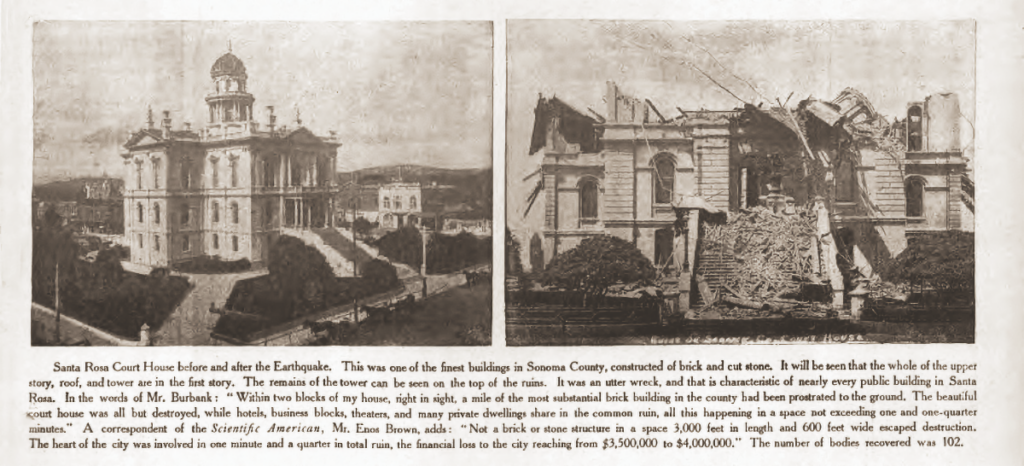
“As we traveled northward, we saw some of the effects of the earthquake; and when we entered San Jose, we could see that large buildings had collapsed, and that others had been seriously damaged. At Mountain View, the new post-office and some of the largest stores in the town had been leveled to the ground. Other buildings had partially collapsed, and were badly wrecked. When we saw the fallen walls of the Pacific Press, we were sad at heart; but we could not help rejoicing over the fact that no lives were lost.”5
The Pacific Press buildings had suffered extensive damage estimated at the time at around $10,000, or $300,000 in today’s currency. Some Adventists had lost their homes, mostly due to the fires that followed the earthquake. The large Adventist church on Laguna Street survived. No one was hurt at the branch sanitarium downtown, though the building was destroyed, as was the vegetarian café, a food store, a home for church workers, and an Adventist doctor’s private sanitarium.
It is hard to comprehend the impact of this terrible disaster on the psyche of the society at the time. Writing in the Auckland Star of New Zealand, correspondent Edward J. Murphy wrote of the many who believed that “the world has come to an end” and that “judgment day has come.” He went on to say, “It seemed as though an infuriated giant demon had reached up from the interior of the earth, buried his steel talons in the fibers of California’s heart, and crushed and tore and shook her into the agonies of death.”6
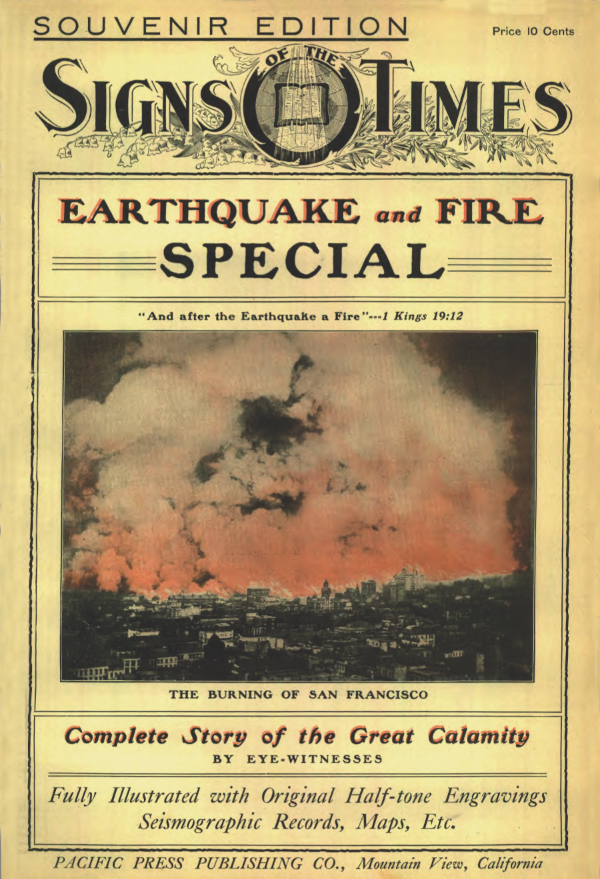
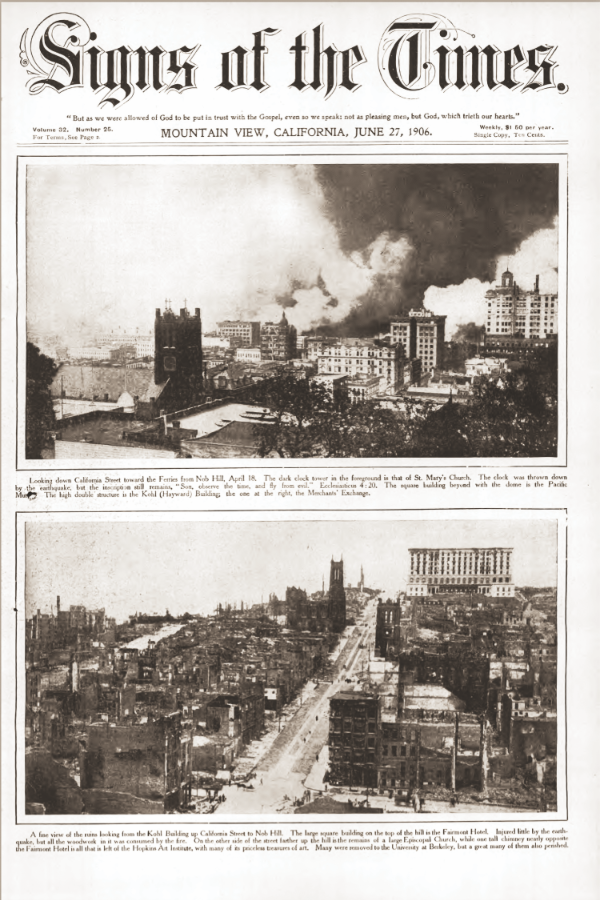
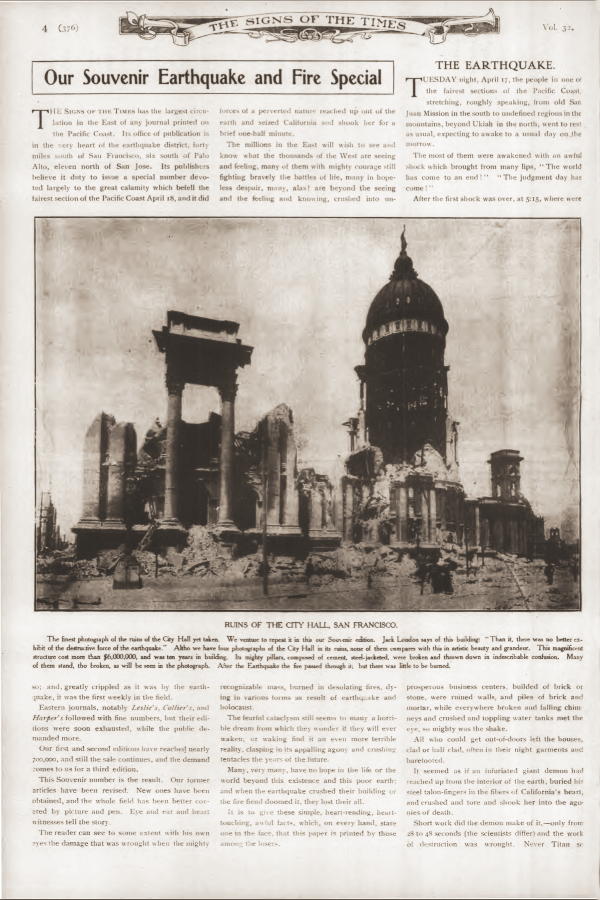
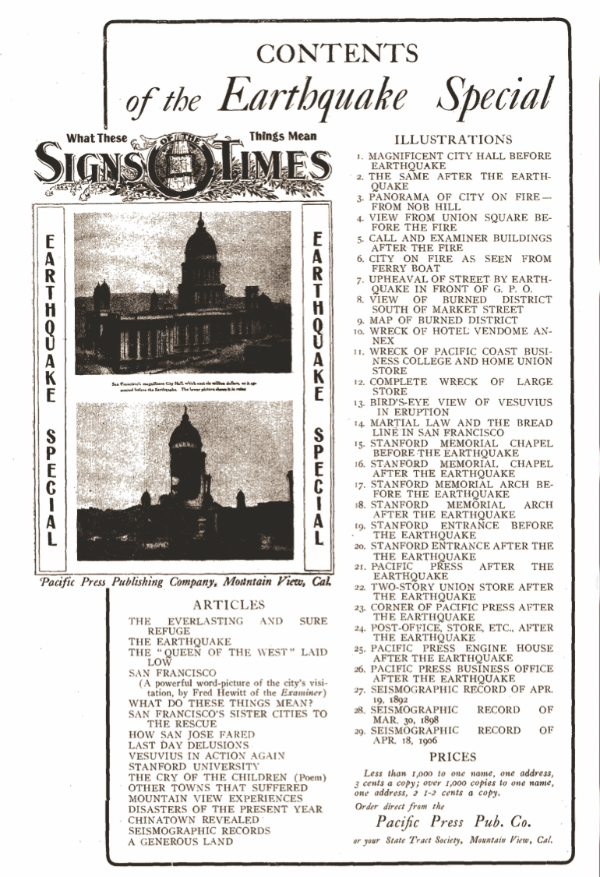
Adventist papers of the time tell a graphic tale of death and destruction, with many photographs of the toll taken by the earthquake. The Signs of the Times issued an “Earthquake Special,” giving the reason that “As the journal having the largest circulation in the East of any paper published on the Pacific Coast, the publishers of the SIGNS OF THE TIMES believe it duty to issue a special number devoted largely to the great calamity which has befallen the fairest section of the Pacific Coast.”7 The “Special” also included a sermon preached by the editor that used the event to point to the importance of a secure spiritual foundation:
There are worldly cities, but there is no sure refuge there. We can not say flee to Oakland or to Chicago or to New York or to London. The next great convulsion may include one or all of these, and the proudest steel towers which men have builded may be reduced to scrap heaps. There is a city which can not be moved, the foundation of which is character. “God hath founded Zion.”… What a mighty contrast is this foundation to that which earthly cities furnish. Those who builded, and thought they builded well on good foundation in San Francisco, made all possible haste to flee in the time of calamity; but he that builds in Zion shall not make haste, or as elsewhere quoted, by Inspiration, “shall not be ashamed or confounded.” No confusion shall come to him who builds on this foundation.8
The “Special” ends with thanks to those of “A Generous Land” who have provided funds and resources to the survivors.9
_____________________________
1Ellen G. White, Life Sketches of Ellen G. White (Mountain View, CA: Pacific Press Pub. Assn., 1915), p. 407.
2White, Life Sketches, p. 409.
3Ellen G. White, “A Visit to Mountain View,” Review and Herald 83, no. 29 (July 19, 1906), p. 7.
4White, Life Sketches, p. 410.
5Ellen White, “The San Francisco Earthquake,” Review and Herald 83, no. 21 (May 24, 1906), p. 7.
6Edward J. Murphy, “Destruction of San Francisco,” Auckland Star, June 30, 1906, p. 14.
7“Our Earthquake Special. Why? Why?” Signs of the Times 32, no. 18 (May 2, 1906), p. 3
8Milton C. Wilcox, “The Everlasting and Sure Refuge,” Signs of the Times 32, no. 18 (May 2, 1906), p. 2.
9“A Generous Land,” Signs of the Times 32, no. 18 (May 2, 1906), p. 16.
Pioneros adventistas en el oeste:
El terremoto de San Francisco
Por el equipo editorial del Recorder
“De camino a casa desde Mountain View, pasamos por San Francisco y, alquilando un carruaje, pasamos una hora y media observando la destrucción causada en esa gran ciudad.” Ellen White
Uno de los eventos más significativos de los primeros días del adventismo en el oeste fue el terremoto de San Francisco en 1906. Ellen White se encontraba en California, asistiendo al servicio de consagración del Loma Linda College of Medical Evangelists y a la dedicación del Sanatorio Paradise Valley. En ese momento tuvo dos visiones, con representaciones de un terrible terremoto, aunque tuvo cuidado de no decir que esas visiones se relacionaran específicamente con lo que iba a suceder poco después en San Francisco. Ella escribió:
“Mientras estaba en Loma Linda, California, el 16 de abril de 1906, se me presentó una representación maravillosa. Durante una visión nocturna, estuve en una colina, desde donde podía ver casas sacudidas como una caña al viento. Edificios, grandes y pequeños, se caían al suelo. Los centros de ocio, teatros, hoteles y las casas de los ricos eran sacudidos y destrozados. Muchas vidas fueron borradas de la existencia, y el aire se llenó con los gritos de los heridos y los aterrorizados.”1
“El 18 de abril, dos días después de que la escena de edificios derrumbándose hubiera pasado ante mí, fui a una cita en la iglesia de Carr Street en Los Angeles. Al acercarnos a la iglesia, oímos a los repartidores de periódicos gritar: ‘¡San Francisco destruida por un terremoto!’ Con el corazón apesadumbrado leí la primera noticia impresa apresuradamente sobre el terrible desastre.”2
Escribió que realmente no quería ver la terrible destrucción. “No quería ver las ruinas de San Francisco”, dijo, “y temía detenerme en Mountain View.”3 Pero no tenía elección.
“De camino a casa desde Mountain View, pasamos por San Francisco y, alquilando un carruaje, pasamos una hora y media contemplando la destrucción causada en esa gran ciudad. Edificios que se creía a prueba de desastres yacían en ruinas. En algunos casos, los edificios estaban parcialmente hundidos en el suelo. La ciudad presentaba un panorama terrible de la ineficiencia de la ingeniosidad humana para establecer estructuras ignífugas y antiterremotos.”4
Escribiendo en la Review and Herald, también compartió su experiencia directa sobre las secuelas del terremoto:
“Mientras viajábamos hacia el norte, vimos algunos de los efectos del terremoto; y cuando entramos en San José, pudimos ver que grandes edificios se habían derrumbado y que otros habían sufrido graves daños. En Mountain View, la nueva oficina de correos y algunas de las tiendas más grandes del pueblo habían sido derrumbadas hasta los cimientos. Otros edificios se habían derrumbado parcialmente y estaban gravemente destrozados. Cuando vimos los muros caídos de la Pacific Press, nos entristeció mucho; pero no pudimos evitar alegrarnos por el hecho de que no se perdieron vidas.”5
Los edificios de la Pacific Press habían sufrido daños extensos estimados en ese momento en unos 10.000 dólares, o 300.000 dólares en la moneda actual. Algunos adventistas habían perdido sus hogares, principalmente debido a los incendios que siguieron al terremoto. La iglesia adventista en Laguna Street sobrevivió. Nadie resultó herido en la sucursal del sanatorio, aunque el edificio fue destruido, al igual que la cafetería vegetariana, una tienda de alimentos, un hogar para obreros de la iglesia y el sanatorio privado de un médico adventista.
Es difícil comprender el impacto de ese terrible desastre en la psique de la sociedad de esa época. Escribiendo en el Auckland Star de Nueva Zelanda, el corresponsal Edward J. Murphy escribió sobre los muchos que creían que “el mundo ha llegado a su fin” y que “el día del juicio había llegado.” Continuó diciendo: “Parecía como si un enfurecido demonio gigante hubiera salido desde el interior de la tierra, enterrado sus garras de acero en las fibras del corazón de California y la hubiera aplastado, desgarrado y sacudido hasta las agonías de la muerte.”6
Los periódicos adventistas de la época cuentan una historia gráfica de muerte y destrucción, con muchas fotografías de las bajas causadas por el terremoto. The Signs of the Times publicó un “Earthquake Special”, explicando que “como la revista con mayor circulación en el este que cualquier otro periódico publicado en la costa del Pacífico, los editores de SIGNS OF THE TIMES consideran su deber publicar un número especial dedicado en gran parte a la gran calamidad que ha afectado la sección más bella de la costa del Pacífico.”7 El “Especial” también incluyó un sermón predicado por el editor que utilizó el evento para señalar la importancia de una base espiritual segura:
Hay ciudades mundanas, pero en ellas no hay refugio seguro. No podemos decir que huyan a Oakland, ni a Chicago, ni a Nueva York, ni a Londres. La próxima gran convulsión puede incluir una o a todas ellas, y las torres de acero más orgullosas que los hombres han construido pueden convertirse en montones de chatarra. Hay una ciudad que no puede caer, cuyo cimiento es el carácter. “Dios ha fundado a Sion”… Qué contraste tan poderoso es este fundamento con lo que proporcionan las ciudades terrenales. Quienes construyeron, y creyeron que se construyeron bien sobre una buena base en San Francisco, se apresuraron a huir en tiempos de calamidad; pero quien edifica en Sion no se apresurará, ni como se cita en otro lugar, por la Inspiración, “no se avergonzará ni se confundirá.” No habrá confusión para quien construya sobre esa base.8
El “Especial” termina con agradecimientos a quienes han aportado fondos y recursos a los supervivientes.9
_____________________________
1Ellen G. White, Life Sketches of Ellen G. White (Mountain View, CA: Pacific Press Pub. Assn., 1915), p. 407.
2White, Life Sketches, p. 409.
3Ellen G. White, “A Visit to Mountain View,” Review and Herald 83, no. 29 (July 19, 1906), p. 7.
4White, Life Sketches, p. 410.
5Ellen White, “The San Francisco Earthquake,” Review and Herald 83, no. 21 (May 24, 1906), p. 7.
6Edward J. Murphy, “Destruction of San Francisco,” Auckland Star, June 30, 1906, p. 14.
7“Our Earthquake Special. Why? Why?” Signs of the Times 32, no. 18 (May 2, 1906), p. 3
8Milton C. Wilcox, “The Everlasting and Sure Refuge,” Signs of the Times 32, no. 18 (May 2, 1906), p. 2.
9“A Generous Land,” Signs of the Times 32, no. 18 (May 2, 1906), p. 16.