
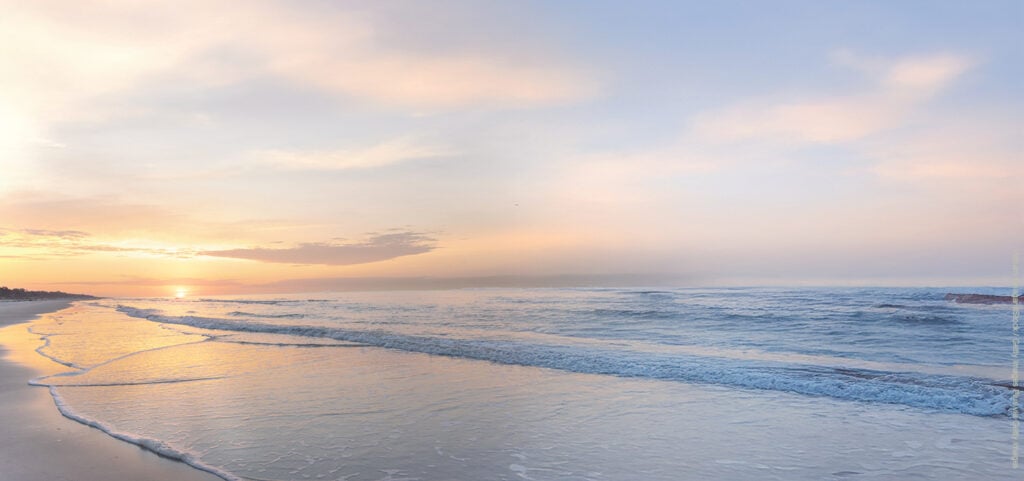
“And God said, ‘Let the water under the sky be gathered to one place, and let dry ground appear.’ And it was so. God called the dry ground ‘land,’ and the gathered waters he called ‘seas.’ And God saw that it was good” (Genesis 1:9-10, NIV).
The Amtrak train that runs from San Luis Obispo, through Los Angeles, and on down to San Diego is called the Pacific Surfliner. It was my chosen means of transport to a meeting I was attending in San Diego, and as we rumbled along from Dana Point to Del Mar, the view from my window was filled with striking views of the ocean and the shoreline. And the beaches.
It made me wish that the Genesis account of creation contained an extra phrase, “And on the third day, God made the beach.” Alas, it is only in the RDT version. But the beach is there, nonetheless. That threshold between the chaotic fluidity of the seas and the stability of the land can be found along virtually every waterway on earth—a riparian ribbon that serves as an ecological gateway. Generally, we just call it the beach.
Whether we live in San Diego or Salt Lake, Tucson or Honolulu, the beach is part of our mental maps. Here in the West, we are ready to give an answer to the question, “How long will it take to get to the beach?” We know our favorite beach and how fast we can get there, as well as the best place to park when we arrive!
For many of us, the ocean or lake or desert shore is no more than a morning’s drive away (under an hour for me). The beach is where we go for birthdays and Sabbath afternoons, campouts and baptisms, graduations and goodbyes. We’ve got the pictures on our phones and framed on the walls of our homes. It’s where we went with our grandparents and where we go with our families now.
Living in the West we remember that for our pioneer forebears who headed west across the plains or deserts, the beach was the destination. The literal end of the road. They kept going west until they couldn’t go any farther. They found themselves face to face with the Pacific, and they knew they were home.
Our family has a favorite beach in Hawaii that we’ve visited many times on our vacations. When our son was ready to be baptized, imagine my delight at learning that what he wanted was for me to do the honors in the shallow waters of our favorite beach! Yes, I love that beach.
Even though I grew up reading the story in Genesis, I had treated those early verses as just a preamble for the more exciting parts of the Creation story, including the creation of Adam and Eve. Looking out my train window as we came into San Onofre, I began to think about the Creator at that foundational moment: as God set out to create our wonderous world, He began by making the beach.
Throughout Scripture, shorelines are often portrayed as places of significance.
Stepping out of the ark onto dry land, Noah gave thanks for the re-emergence of the land and claimed the promise written in the rainbow above him.
Baby Moses in his tiny ark of bullrushes, set afloat but never abandoned, was fished out of the Nile by a princess and slowly discovered the importance of this shoreline rescue. As an adult, he carefully guided God’s people on a sandy path through the waters of the Red Sea and through the wilderness. It fell to Joshua, years later, to lead Israel across the Jordan on dry land into the long awaited promised land.
Determined to avoid God’s call, Jonah set out on a journey that became more perilous with every passing hour. Wanting no part of this misguided odyssey, his companions tossed him overboard, and in short order he was swallowed by a great fish. After a long weekend of self-reflection in the most unsatisfactory of places, the fish spit him up—right onto the beach. It was from there that his journey back to life and the understanding of grace began again.
Directed by God, Elijah escaped a lengthy drought by camping out on the banks of the brook Cherith. Ravens brought him bread and meat each day, and his life was sustained.
In a beach story that Jesus Himself retold, Elisha sent Naaman to dip in the waters of the Jordan River to be healed. The thought angered Naaman, and he resisted the prophet’s command, but after his health was restored, he returned to the prophet and asked if he could take some of the earth (the beach!) home with him.
The beach stories in the New Testament are fewer in number but among the scenes we know the best.
Jesus sought His first disciples from among the men who made their livelihood in the waters of the Sea of Galilee and called the beach their home. How well we know the names of those who responded to His call to become “fishers of men”!
The beach is the environment for the ministry of Jesus as He journeyed around the Sea of Galilee with His followers, turned a boat anchored in shallow waters into a floating stage to speak to the crowds, stilled a storm that was preventing a safe return to the harbor, and even walked on the water itself—a miracle that defied the essential difference between the water and the shore.
In the wake of the upheaval created by the crucifixion and the resurrection, the disciples sought to make sense of things by going back to the same beach where they began their journey with Jesus. And it was here that they encountered their beloved Lord in a new and transforming way.
The disciples had gone back to fishing. One morning, they saw a lone figure on the beach who seemed familiar. Excitedly, they returned to the beach—Peter actually jumped into the water and swam ashore. In one of the most memorable and touching scenes in the Gospels, they found that the risen Christ, tending a small fire, had made breakfast for these, His closest colleagues and followers. Breakfast on the beach! I imagine the gray skies clearing as the water lapped against the shoreline, and all those things that needed to be worked through were resolved right there on the beach. Peter rediscovered the calling that he would never again betray, and the church of Christ began to take shape.
Revelation contains two final “beach” stories. John the Revelator was exiled to the island of Patmos and received an epic vision of the future in which God’s people are assembled on the sea of glass before the throne of God. We can only imagine this glorious scene! And then, near the end of his vision, there was a vivid description of the river of life, flowing from the throne of God: “On each side of the river stood the tree of life, bearing twelve crops of fruit, yielding its fruit every month. And the leaves of the tree are for the healing of the nations” (Revelation 22:2, NIV).
Across the grand arc of the stories of Scripture, from the first verses to the last, the beach as a place of God’s activity—as well as God’s care—can be seen over and over. The prophet Jeremiah affirmed God’s purposes: “I made the sand a boundary for the sea, an everlasting barrier it cannot cross. The waves may roll, but they cannot prevail; they may roar, but they cannot cross it” (Jeremiah 5:22, NIV).
So, find your beach. As the weather gets warmer and we seek our favorite shorelines, we can also find those inner places where we process through the transitions, evaluate where we’ve come from, think through where we are headed, and discover anew God’s grace and leading.
_____________________________
Ray Tetz is the director of communication and community engagement of the Pacific Union and the publisher of the Recorder.
La última palabra Encuentra tu playa
Por Ray Tetz
«Y Dios dijo: “Que el agua bajo el cielo se reúna en un solo lugar, y que aparezca tierra seca”. Y así fue. Dios llamó a la tierra seca “tierra”, y a las aguas reunidas las llamó “mares”. Y Dios vio que era bueno» (Génesis 1:9-10).
El tren de Amtrak que va de San Luis Obispo, pasa por Los Angeles y sigue hasta San Diego se llama Pacific Surfliner. Era mi medio de transporte elegido para una reunión a la que asistía en San Diego, y mientras avanzábamos de Dana Point a Del Mar, la vista desde mi ventana estaba llena de impresionantes vistas del océano y la costa. Y las playas.
Me hizo desear que el relato del Génesis sobre la creación contuviera una frase extra: «Y al tercer día, Dios hizo la playa». Por desgracia, solo está en la versión RDT. Pero la playa está ahí. Ese umbral entre la fluidez caótica de los mares y la estabilidad de la tierra se encuentra a lo largo de prácticamente todos los cursos de agua del mundo: una cinta ribereña que sirve como puerta ecológica. Generalmente, simplemente la llamamos la playa.
Vivamos en San Diego, Salt Lake, Tucson o Honolulu, la playa forma parte de nuestro mapa mental. Aquí en el oeste, estamos listos para responder a la pregunta: «¿Qué tan lejos está la playa?» Conocemos nuestra playa favorita y lo rápido que podemos llegar, ¡además de cuál es el mejor sitio para aparcar cuando llegamos!
Para muchos de nosotros, el océano, el lago o la orilla del arroyo en el desierto está a no más de una mañana en coche (menos de una hora para mí). La playa es donde vamos para cumpleaños y tardes de sábado, acampar y bautizos, graduaciones y despedidas. Tenemos las fotos en nuestros móviles y enmarcadas en las paredes de nuestras casas. Es donde fuimos con nuestros abuelos y a donde vamos ahora con nuestra familia.
Viviendo en el oeste, recordamos que para nuestros pioneros que se dirigieron hacia el oeste a través de las llanuras o desiertos, la playa era su destino. El final literal del camino. Siguieron hacia el oeste hasta que no pudieron avanzar más. Se encontraron cara a cara con el Pacífico y supieron que estaban en casa.
Nuestra familia tiene una playa favorita en Hawaii a la que hemos visitado muchas veces durante nuestras vacaciones. Cuando nuestro hijo estuvo listo para ser bautizado, imagina mi alegría al saber que lo que él quería era que yo hiciera los honores en las aguas poco profundas de nuestra playa favorita. Sí, me encanta esa playa.
Aunque crecí leyendo la historia en Génesis, trataba a esos primeros versículos como un preámbulo para las partes más emocionantes de la historia de la Creación, incluida la creación de Adán y Eva. Mirando por la ventana de mi tren al llegar a San Onofre, empecé a pensar en el Creador en ese momento fundamental: cuando Dios se propuso crear nuestro maravilloso mundo, empezó haciendo la playa.
A lo largo de las Escrituras, las orillas suelen representarse como lugares de importancia.
Al salir del arca y pisar tierra firme, Noé dio gracias por la reaparición de la tierra y reclamó la promesa escrita en el arcoíris sobre él.
El bebé Moisés, en su pequeño arca de juncos, flotado pero nunca abandonado, fue rescatado del Nilo por una princesa y poco a poco descubrió la importancia de ese rescate en la orilla del río. De adulto, guió cuidadosamente al pueblo de Dios por un sendero arenoso a través de las aguas del Mar Rojo y a través del desierto. Años después, le tocó a Josué guiar a Israel a través del Jordán en tierra firme hacia la tan esperada tierra prometida.
Decidido a evitar el llamado de Dios, Jonás emprendió un viaje que se volvió más peligroso con cada hora que pasaba. Sin querer formar parte de esa odisea equivocada, sus compañeros lo arrojaron por la borda y, al poco tiempo, fue tragado por un gran pez. Tras un largo fin de semana de reflexión en el lugar más insatisfactorio, los peces le escupieron directamente en la playa. Fue a partir de ahí cuando comenzó de nuevo su viaje de vuelta a la vida y la comprensión de la gracia.
Dirigido por Dios, Elías escapó de una larga sequía acampando en las orillas del arroyo Cherith. Los cuervos le traían pan y carne cada día y su vida se sostuvo de esa manera.
En una historia de playa que Jesús mismo contó, Eliseo envió a Naamán a bañarse en las aguas del río Jordán para ser sanado. El pensamiento enfadó a Naamán, que resistió la orden del profeta, pero tras recuperar la salud, regresó al profeta y le pidió si podía llevarse parte de la tierra (¡la playa!) a su casa.
Las historias de playa en el Nuevo Testamento son menos numerosas, pero entre las escenas las que mejor conocemos.
Jesús buscó a sus primeros discípulos entre los hombres que se ganaban la vida en las aguas del mar de Galilea y que consideraban a la playa su hogar. ¡Qué bien conocemos los nombres de quienes respondieron a su llamado para convertirse en «pescadores de hombres»!
La playa es el entorno para el ministerio de Jesús mientras recorría el mar de Galilea con sus seguidores, convertía un barco anclado en aguas poco profundas en un escenario flotante para hablar con la multitud, calmaba una tormenta que impedía un regreso seguro al puerto e incluso caminaba sobre el agua misma; un milagro que desafiaba la diferencia esencial entre el agua y la orilla.
Tras la agitación provocada por la crucifixión y la resurrección, los discípulos buscaron dar sentido a las cosas regresando a la misma playa donde comenzaron su viaje con Jesús. Y fue allí donde encontraron a su amado Señor de una manera nueva y transformadora.
Los discípulos habían vuelto a pescar. Una mañana, vieron una figura solitaria en la playa que les resultaba familiar. Emocionados, volvieron a la playa. Pedro saltó al agua y nadó hasta la orilla. En una de las escenas más memorables y conmovedoras de los Evangelios, encontraron que Cristo resucitado, atendiendo una pequeña hoguera, había preparado el desayuno para ellos, sus colegas y seguidores más cercanos. ¡Un desayuno en la playa! Imagino el cielo gris despejándose mientras el agua lamía la orilla, y todas esas cosas que había que resolver se resolvían allí mismo, en la playa. Pedro redescubrió la vocación que nunca volvería a traicionar y la iglesia de Cristo comenzó a tomar forma.
El Apocalipsis contiene dos historias finales de «playa». Juan el Revelador fue exiliado a la isla de Patmos y recibió una visión épica del futuro en la que el pueblo de Dios se reúne en el mar de cristal ante el trono de Dios. ¡Solo podemos imaginar esa escena gloriosa! Y entonces, cerca del final de su visión, hubo una vívida descripción del río de la vida, que fluye desde el trono de Dios: «A cada lado del río estaba el árbol de la vida, dando doce cosechas de frutos, dando frutos cada mes. Y las hojas del árbol son para la salud de las naciones» (Apocalipsis 22:2).
A lo largo del gran arco de las historias de las Escrituras, desde los primeros versículos hasta el último, la playa como lugar de la actividad de Dios —así como del cuidado de Dios— puede verse una y otra vez. El profeta Jeremías afirmó los propósitos de Dios: «Hice de la arena un límite para el mar, una barrera eterna que no puede cruzar. Las olas pueden rodar, pero no pueden prevalecer; pueden rugir, pero no pueden cruzarlo» (Jeremías 5:22).
Así que, encuentra tu playa. A medida que el tiempo se vuelve más cálido y buscamos nuestras orillas favoritas, también podemos encontrar esos lugares interiores donde procesamos las transiciones, evaluamos de dónde venimos, reflexionamos sobre hacia dónde nos dirigimos y descubrimos de nuevo la gracia y el liderazgo de Dios.
_____________________________
Ray Tetz es director de comunicación y compromiso comunitario de la Pacific Union y director del Recorder.