
By Milly Pardo
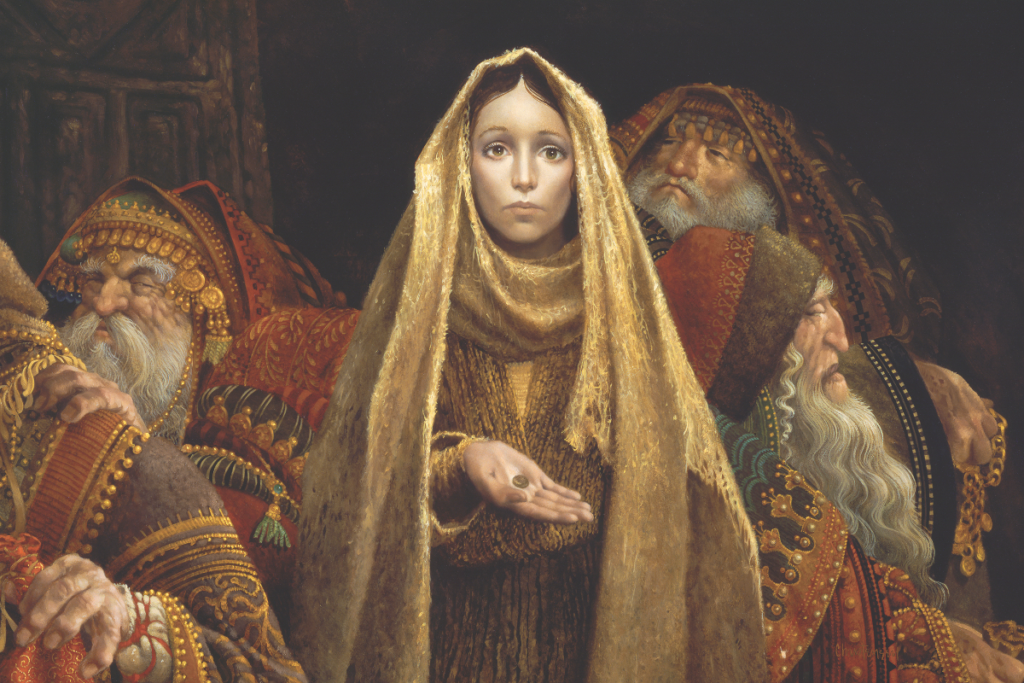
The widow moved quietly through the crowd, almost invisible among the rustle of robes, the metallic echo of coins, the solemnity of religion dressed in marble and gold. Nobody noticed her except Jesus. The rich arrived with the confidence that wealth always brings. Their offerings rang loudly against the brass receptacles, announcing themselves with the kind of noise that often substitutes for virtue. But the widow carried only two small copper coins, thin and nearly weightless—the sort of coins that disappear in the cracks of the world without anyone bending down to look for them.
Yet somehow those two coins became heavier than the stones of the Temple itself.
For years I heard that story explained as an example of generosity, a lesson in stewardship designed to encourage people to give more to the church. The widow, we were told, was the perfect believer because she surrendered everything she possessed. The story was repeated and polished until it lost the dust and sorrow of real life.
But perhaps the story is not about generosity at all. Perhaps it is about a system so consumed with preserving itself that it could watch a hungry widow empty her hands and still congratulate itself for being holy.
Jesus had already spent days confronting the machinery of religion. He walked through courts glittering with wealth while poverty lingered in the shadows. Others saw permanence; He saw collapse. Others saw devotion; He saw exhaustion. Others heard prayers; He heard the grinding thud of burdens laid upon people already carrying too much. The widow appears almost like the final sentence of that long argument.
She does not walk away blessed with abundance. Jesus does not stop her before she drops the coins. He simply watches. Then He calls the disciples to look carefully, as though this frail woman standing before the treasury reveals more truth about the nation than all the speeches of priests and scholars combined.
The remarkable thing is not merely that she gave little. The remarkable thing is that nobody had protected her from becoming so desperate in the first place.
In the ancient world, widows often lived near the edge of survival. Without a husband, property, or legal standing, many depended entirely upon family or community compassion. Scripture repeatedly insisted that widows, strangers, and orphans were to be cared for and remembered. A society was judged not by the splendor of its temple but by the way it treated its weakest souls. And yet there she stood, alone.
I have seen versions of that widow in many places. Sometimes she is elderly and sitting quietly in the back pew, slipping folded dollars into an offering plate while worrying about rent. Sometimes it is a lonely person giving time, energy, loyalty, affection—until there is nothing left except exhaustion. Institutions, churches, families, even friendships can slowly consume people while convincing them that sacrifice alone is holiness. But Jesus never glorified exploitation.
Again and again, He moved toward those crushed beneath invisible weight. He fed hungry crowds before preaching theology to them. He healed before demanding loyalty. He defended those society ignored. Religion for Him was never meant to become a machine that devoured human beings in order to sustain itself.
That is why the widow’s coins feel less like a triumph and more like an indictment. Her offering exposed something broken at the center of the system itself.
The disciples probably admired the Temple. Everyone did. Massive stones. Towering walls. National pride wrapped in sacred memory. But Jesus looked at those same stones and spoke of destruction. Not one stone left upon another. Perhaps the collapse had already begun long before the Romans arrived. Maybe any structure begins dying the moment it values itself more than the people it was meant to serve.
The widow’s two coins were small enough to disappear in the treasury but large enough to expose an entire moral failure. And maybe that is why Jesus pointed to her. Not because God delights in watching the poor surrender their last breath to religious obligation, but because heaven notices what the world ignores. Christ saw what others refused to see: a fragile life standing beneath the crushing weight of public holiness.
The tragedy of the story is not that the widow gave too little. It is that she had so little left to give.
_____________________________
Milly Pardo, a retired social worker, writes from Southern Florida.
Las monedas que pesaban más que la piedra
Por Milly Pardo
La viuda se movía silenciosamente entre la multitud, casi invisible entre el susurro de las túnicas, el eco metálico de las monedas, la solemnidad de la religión vestida de mármol y oro. Nadie la notó excepto Jesús. Los ricos llegaron con la confianza que la riqueza siempre trae. Sus ofrendas resonaban con fuerza contra los recipientes de latón, anunciándose con el tipo de ruido que a menudo sustituye la virtud. Pero la viuda solo llevaba dos pequeñas monedas de cobre, delgadas y casi ingrávidas —el tipo de monedas que desaparecen en las grietas del mundo sin que nadie se agache a recogerlas.
Sin embargo, de alguna manera esas dos monedas se volvieron más pesadas que las piedras del mismo templo.
Durante años escuché esa historia explicada como un ejemplo de generosidad, una lección de responsabilidad para animar a las personas a dar más a la iglesia. Nos dijeron que la viuda era la creyente perfecta porque entregó todo lo que poseía. La historia se repitió y se pulió hasta que perdió el polvo y la tristeza de la vida real.
Pero quizá la historia no trate en absoluto la generosidad. Quizá trate con un sistema tan obsesionado con preservarse que podría ver a una viuda hambrienta dar su todo y aun así felicitarse por ser santo.
Jesús ya había pasado días enfrentándose a la maquinaria de la religión. Caminaba por las cortes brillando de riqueza mientras la pobreza persistía en las sombras. Otros vieron permanencia; él vio colapso. Otros veían devoción; él vio agotamiento. Otros escuchaban oraciones; él escuchó el golpe estridente de las cargas que cargaban con demasiado. La viuda parece casi la frase final de ese largo argumento.
No se va bendecida con abundancia. Jesús no la detiene antes de que deje caer las monedas. Simplemente observa. Entonces llama a los discípulos a mirar con atención, como si esa frágil mujer que se encuentra ante el tesoro revelara más verdad sobre la nación que todos los discursos de sacerdotes y eruditos.
Lo notable no es solo que ella diera poco. Lo sorprendente es que nadie la había protegido de estar en una condición tan desesperada en primer lugar.
En el mundo antiguo, las viudas solían vivir cerca del límite de la supervivencia. Sin marido, propiedad o posición legal, muchas dependían enteramente de la compasión familiar o comunitaria. Las Escrituras insistían repetidamente en que las viudas, extraños y huérfanos debían ser cuidados y recordados. Una sociedad no era juzgada por el esplendor de su templo, sino por la forma como trataba a sus almas más débiles. Sin embargo, allí estaba, sola.
He visto versiones de esa viuda en muchos sitios. A veces es mayor y está sentada tranquilamente en el banco trasero, deslizando dólares doblados en un plato de ofrendas mientras se preocupa por el alquiler. A veces es una persona solitaria que da tiempo, energía, lealtad, afecto —hasta que no le queda nada salvo agotamiento. Las instituciones, iglesias, familias e incluso amistades pueden consumir lentamente a las personas mientras las convencen de que el sacrificio por sí mismo es santidad. Pero Jesús nunca glorificó la explotación.
Una y otra vez, iba hacia aquellos aplastados bajo un peso invisible. Alimentaba a multitudes hambrientas antes de predicarles teología. Sanó antes de exigir lealtad. Defendió a los ignorados por la sociedad. La religión para él nunca estuvo destinada a convertirse en una máquina que devorara a los seres humanos para sostenerse.
Por eso las monedas de la viuda se sienten menos como un triunfo y más como una acusación. Su ofrenda expuso algo quebrantado en el centro del mismo sistema.
Probablemente los discípulos admiraban el Templo. Todos lo hacían. Piedras enormes. Muros imponentes. Orgullo nacional envuelto en memoria sagrada. Pero Jesús miró esas mismas piedras y habló de destrucción. Ni una piedra sobre otra. Quizá el colapso ya había comenzado mucho antes de la llegada de los romanos. Quizá cualquier estructura empiece a morir en el momento en que se valora más a sí misma que a las personas a las que está destinada a servir.
Las dos monedas de la viuda eran lo suficientemente pequeñas como para desaparecer en el tesoro, pero lo bastante grandes como para exponer un total fracaso moral. Quizá por eso Jesús la señaló. No porque Dios disfrute viendo a los pobres entregar su último aliento a la obligación religiosa, sino porque el cielo nota lo que el mundo ignora. Cristo vio lo que otros se negaron a ver: una vida frágil bajo el peso aplastante de la santidad pública.
La tragedia de la historia no es que la viuda diera muy poco. Es que le quedara tan poco para dar.
_____________________________
Milly Pardo, trabajadora social jubilada, escribe desde el sur de la Florida.